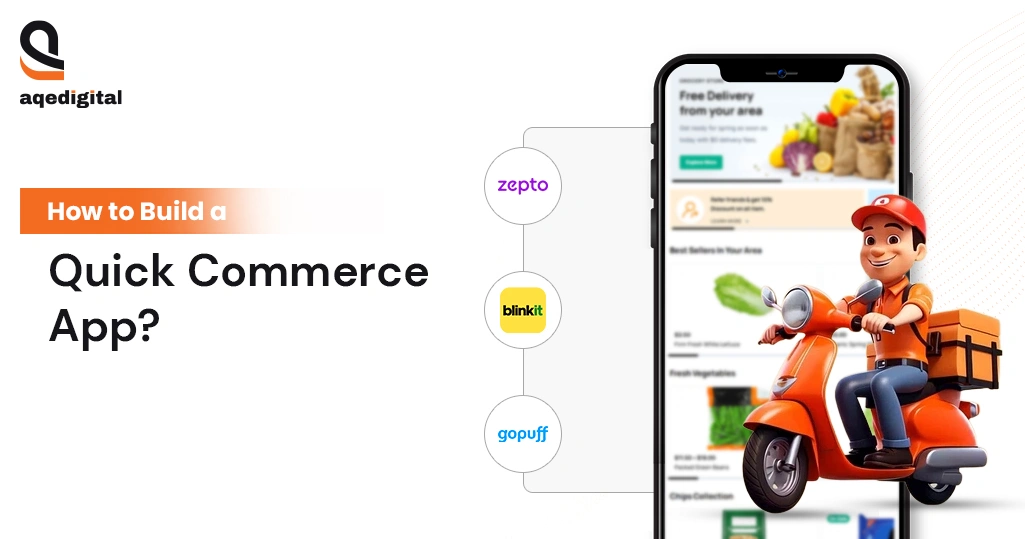
The rules of retail have changed. Customers no longer wait days—or even hours—for essentials. They want groceries in 10 minutes, medicines in 20, and snacks before the movie starts. This isn’t eCommerce as we know it—it’s Quick Commerce (Q-commerce), powered by Quick Commerce Apps.
👉 Curious how it works? Dive into the full guide here: Quick Commerce App
What Makes Quick Commerce Different?
Unlike traditional eCommerce, Quick Commerce Apps don’t rely on sprawling warehouses. They operate through dark stores and micro-fulfillment centers, strategically placed within city neighborhoods. Add AI-driven logistics, real-time inventory tracking, and ultra-fast riders, and you’ve got a system built for delivery in minutes—not days.
This is more than convenience—it’s consumer psychology. Once customers get used to instant gratification, it becomes the baseline for every future purchase.
Why Businesses Are Racing Toward Q-Commerce
- The global Q-commerce market is set to surpass $330B by 2032 at nearly 10% CAGR (Fortune Business Insights
- In India, quick commerce hit ₹64,000 crore in FY 2025 and may triple by FY 2028 (Times of India
- Q-commerce already contributes to 20% of India’s eCommerce market, with 50% year-on-year growth (Economic Times
The message is clear: Speed isn’t a feature—it’s a growth engine.
The Benefits Businesses Can’t Ignore
- Customer Retention: Faster delivery = stronger loyalty.
- More Orders, More Often: Customers make frequent, smaller purchases.
- Competitive Edge: “Delivery in minutes” is a USP that sets you apart.
- Smarter Operations: Data-rich insights on demand patterns and inventory flow.
- Urban Dominance: The denser the city, the stronger the model.
Who’s Winning the Race?
- Blinkit, Zepto, Swiggy Instamart (India): Redefining how urban households shop.
- Gopuff (US), Getir & Gorillas (Europe): Building international momentum with sub-30-minute delivery models.
- Amazon & Walmart: Experimenting with Q-commerce-like services to protect market share.
The Hard Truth: Challenges Ahead
- Profitability pressures from discounts + high delivery costs (FT
- ).
- Scaling issues in low-density towns where dark stores aren’t viable.
- Complex logistics—predicting demand, avoiding spoilage, and optimizing routes.
- Customer expectations that only rise with every order.
The Playbook for Businesses Entering Q-Commerce
- Begin with dense metro clusters where demand is high.
- Use AI to predict demand and optimize rider dispatch.
- Keep dark store SKUs lean—focus on high-velocity products.
- Offer premium delivery subscriptions for frequent users.
- Maintain real-time transparency for customers—stock, ETA, tracking.
The Bottom Line
Quick commerce isn’t a trend—it’s the next evolution of digital retail. For businesses, it’s both an opportunity and a challenge: capture the market now, or risk being left behind by players who can deliver in minutes.
👉 For strategies, frameworks, and detailed use cases, read the full breakdown: Quick Commerce App




Comments (0)
Login to post a comment.